Quick answer: The terms overlap in everyday use. A PG (paying guest) is usually a room or bed in a house or small building, often with meals and an owner or manager nearby. A hostel is typically larger and more institutional, with several residents per room and set rules and timings. Co-living is a newer, more branded format with furnished rooms, shared spaces, services and flexible terms. The right model depends on your building, capital, target tenants and how much operations you can handle. Definitions vary by city and by operator, and rules can differ by type.
If you are deciding what to open, or how to position what you have, the labels matter because tenants search by them, and because regulations may treat them differently. This guide compares the three in practical terms. It is general information, not legal advice.
The three models at a glance
| Factor | PG | Hostel | Co-living |
|---|---|---|---|
| Typical size | Few to several dozen beds | Often larger | Medium to large, often multiple buildings |
| Setting | House, flat or small building | Dedicated building or floors | Purpose-fitted building or branded space |
| Rooms | Single, double, triple sharing | Often multi-bed dorms or shared rooms | Private or shared, furnished and designed |
| Food | Often included | Often mess or canteen | Optional meals, cafe or pantry |
| Services | Housekeeping, Wi-Fi, laundry (varies) | Basic services and rules | Housekeeping, community events, high-speed internet, app-based services |
| Rules | House rules, often informal | Formal rules and timings | Lighter rules, community guidelines |
| Stay length | Months | Semester or year | Flexible, from short to long |
| Pricing | Value to mid | Budget | Mid to premium |
| Operations | Owner or small team | Warden and staff | Professional team and systems |
These are tendencies. Many operators blend them.
PG: strengths and limits
Strengths
- Lower start-up cost
- Simple to start in an existing house or flat
- Flexible: you can adapt to your area
- Personal attention from the owner or manager
Limits
- Quality varies, and tenants may distrust informal setups
- Owner dependence for daily work
- Limited scalability if processes are informal
- Compliance may be unclear or ignored
Best for: owners with an existing property, local knowledge and a wish to start small.
Hostel: strengths and limits
Strengths
- Can serve many residents in one building
- Clear rules and structure
- Suited to students and institutions
- Predictable demand near colleges
Limits
- Strong seasonality. See PG seasonality
- Needs more staff, food service and safety systems
- Higher compliance expectations in many areas
- Lower pricing power in budget segments
Best for: operators near colleges or institutions with capacity for structured management.
Co-living: strengths and limits
Strengths
- Premium positioning and pricing for working professionals
- Flexible terms attract mobile talent
- Community and services create loyalty
- Brandable and scalable if systems are strong
Limits
- Higher fit-out and operating costs
- Need for professional systems and team
- Sensitive to quality and service expectations
- Sensitive to market cycles and employer demand
- More complex pricing, sometimes with add-ons
Best for: operators with capital, design and operations capability, targeting working professionals in strong job markets.
Which tenants each attracts
- PG: students, early-career professionals, people who value home-like food and a personal touch.
- Hostel: students, trainees, budget-conscious residents.
- Co-living: working professionals, young managers, people relocating for work who want convenience and flexibility.
Always check your local demand. Walk through competing properties and talk to residents.
Compliance and legal notes
There is no single national framework for PGs, hostels and co-living. Requirements depend on state, city and building use. A property marketed as a hostel or co-living may face different expectations from one run as a PG. Check:
- registration or licensing
- fire safety
- building use and zoning
- police verification
- food safety, if serving meals
- tax treatment
See PG licensing and municipal compliance, fire safety checklist and leave and license vs tenancy. Consult a lawyer and a CA for your situation.
How to choose
Ask these questions:
- Who is my tenant? Students, professionals or both.
- What building do I have or can I get?
- How much capital can I invest?
- How many beds can I fill reliably?
- Can I manage staff and services?
- What do competitors offer, and what is missing?
- What does my break-even look like? See break-even occupancy
- How do I want to grow? One property or a chain.
If you are unsure, start with a well-run PG or small hostel model, prove demand and operations, and upgrade services as you learn.
Moving up the ladder
Many operators evolve: start as a PG, improve processes and facilities, add services and branding and shift toward co-living in a strong market. To do this, build systems early:
- tenant onboarding and eKYC
- digital agreements
- automated rent collection
- complaint tracking
- clear reports for each property
See how to run multiple PG properties from your phone and opening a second branch.
Common mistakes
- Choosing a label without understanding the operations
- Overspending on branding while basics are weak
- Ignoring local compliance
- Pricing for a segment you do not serve
- Not matching services to tenant type
- Scaling before systems are ready
- Copying a model from another city blindly
How software helps
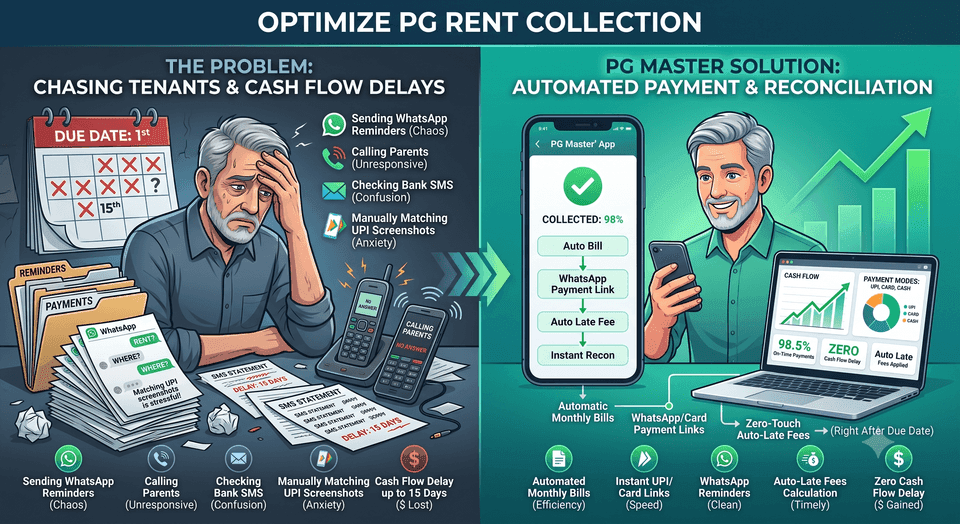
Whatever you call it, you are running beds, tenants, rent and services. The PG Master Owner App supports PGs, hostels and multi-property operators with rent collection, live bed tracking, tenant records and expense tracking. See multi-property chain control.
Positioning matters as much as the label
Whatever you choose to call it, tenants judge you by what they see and experience. A PG that is clean, safe, well run and clearly priced can outcompete a co-living space that promises more than it delivers. Equally, a co-living brand that delivers a great experience can justify a higher price. Describe your property honestly in your listing, and use the term that your target tenants search for in your city. Check how nearby competitors describe themselves, and look at the words used in reviews. Match your promise to your reality, then improve the reality.
Frequently asked questions
What is the difference between a PG and a hostel? A PG is usually smaller and more home-like, often with an owner nearby. A hostel is typically larger with more structured rules. The terms overlap, and usage varies.
What is co-living? A furnished, service-rich shared living format, often branded, with flexible terms and community features, aimed mostly at working professionals.
Which is more profitable? It depends on occupancy, pricing, costs and management. Calculate profit per bed for your own plan.
Do the same rules apply to all three? Not necessarily. Rules vary by state, city and how the property is classified. Check locally.
Can I start as a PG and become co-living later? Yes, many do. Build good systems and reputation first, then add services and upgrade the experience.
Next step
Write down your target tenant and building, then compare the three models using the table above. When you are ready to run your property professionally, try the PG Master Owner App or book a demo.
Stop Chasing Rent & Juggling Spreadsheets
ApnaRent helps 170+ owners send automated WhatsApp rent reminders, track live bed vacancy, collect digital KYC, and reconcile expenses in real time.