
Quick answer: PG demand follows the tenant type. Student PGs usually fill around admission and semester starts and thin out during exams, summer and vacations. Working-professional PGs are steadier but move with hiring cycles, appraisal and joining seasons. Look at your own occupancy by month for two years to find your pattern, then plan marketing, pricing, notice terms and maintenance around it. The months and cycles below are general patterns, not guarantees.
If your PG empties every year at the same time and you are surprised, you are paying a recurring tax on a predictable pattern. Seasonality is not a problem you can eliminate, but you can prepare for it. The first step is knowing which season your PG depends on.
Two broad tenant types
Students
Student demand follows the academic calendar of nearby colleges, coaching institutes and entrance exams. In many places, admissions and counselling happen in the months before a session starts, and demand rises just before and at the start of classes. Beds can empty after exams or at the end of a course, and during long vacations.
Typical patterns
- Rush before admission and semester start
- Partial vacancy during mid-term breaks
- High vacancy during long holidays
- Sensitivity to exam schedules, result dates and counselling rounds
- Strong dependence on one or two institutions
Working professionals
Professionals move for jobs, internships and transfers. Demand is more spread out, but still has patterns: hiring seasons, campus joinings, project starts and appraisal cycles. Some move out after short assignments or when they marry or shift to a flat.
Typical patterns
- Steady year-round demand in business areas
- Peaks around joining seasons for fresh graduates
- Drops after layoffs or hiring freezes at nearby employers
- Preference for flexible terms and amenities
- Dependence on a few large employers in the area
Many PGs host both groups. Mixed occupancy can smooth the year.
Find your own pattern
Do not copy generic calendars. Use your own data.
- List occupied beds at the end of each month for the last 12 to 24 months.
- Calculate occupancy for each month. See how to calculate PG occupancy rate.
- Note move-ins and move-outs by month.
- Note reasons for moving out: exams over, course ended, job change, relocation.
- Mark local events: admissions, results, campus drives.
After two cycles, you will see your busy and slow months. If you have a year of data, treat it as a hypothesis and update.
Plan marketing in advance
Start marketing before the busy period, not during it.
| Period | Action |
|---|---|
| 6 to 8 weeks before peak | Refresh photos, update listing, contact last year's referrals |
| 4 weeks before | Publish availability and booking tokens |
| Peak | Respond quickly, keep availability accurate |
| After peak | Collect reviews, ask for referrals |
| Slow season | Offer flexible terms, target other segments |
Link with college offices, coaching centres and company HR teams where appropriate. See how to fill empty beds in 30 days.
Pricing and terms by season
You can manage demand with terms rather than only price.
- Peak: Hold prices, take booking tokens, encourage longer commitments.
- Slow: Consider short-stay options, flexible move-in dates or a limited-time inclusion such as laundry or a meal plan, rather than blanket discounts.
- Long vacation: Offer a retainer or reduced vacation rent to students who return, so you keep their bed. State the terms in writing.
- Notice and lock-in: Align them with your cycle. See notice period and lock-in rules.
Be careful with deep discounts. They can reset expectations and attract tenants who leave when prices rise.
Diversify your tenant base
If one college or employer drives most of your demand, you carry a concentration risk. Consider:
- adding rooms for professionals if you are student-heavy
- offering short-stay beds for interns, exam candidates and visiting staff
- widening your marketing beyond one institution
- converting some rooms to different types of sharing
Do this gradually and check your area's demand first.
Use slow months well
An empty period is also a window for work you cannot do when beds are full:
- Repainting and repairs
- Deep cleaning and pest control
- Electrical and plumbing inspection
- Replacing mattresses and furniture
- Updating photos and listings
- Training staff
- Reviewing pricing and policies
You protect your future occupancy by making the next season smoother.
Forecast cash flow
If you know that two months a year will have lower income, plan for it:
- Keep a reserve equal to some months of fixed costs
- Time large purchases outside slow months
- Negotiate payment terms with vendors where possible
- Review your break-even occupancy. See break-even occupancy for a PG.
Common mistakes
- Starting marketing after the peak has begun
- Discounting too early in a slow period
- Depending on one institution
- Not tracking monthly occupancy
- Using slow months for nothing
- Ignoring cash flow gaps
- Letting standards slip when the PG is full
How software helps
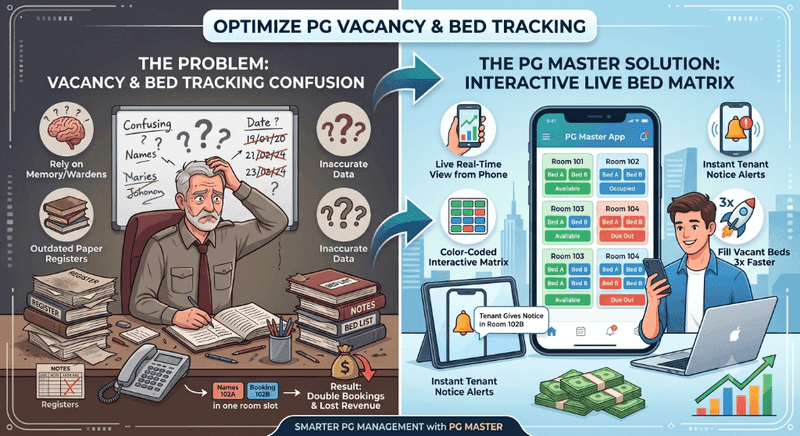
Seasonal planning needs history. The PG Master Owner App keeps occupancy and move-in/move-out data by property so you can see how your beds fill over time. See live bed occupancy tracking.
An example of a seasonal plan for a student PG
Suppose most of your tenants are students who join in the months after admissions and leave after exams. In the weeks before admissions, refresh the listing, contact last year's students for referrals and open pre-booking with a token. During the term, focus on retention and reviews. After exams, offer a small retainer for students who plan to return, and open short-stay beds for exam candidates or interns. In the vacation, repaint and repair. Before the next session, repeat. This cycle turns a pattern that feels like a problem into a calendar you can plan against.
Using referrals to smooth demand
Referrals are the cheapest way to fill beds at the edges of a season. In the weeks before a busy period, ask your satisfied tenants whether any juniors, colleagues or friends are looking for a place. Offer a small reward when a referral joins and stays for a set period. Keep the terms written and fair. Also ask local coaching centres and HR contacts to share your details with new joiners. Referral leads usually convert better than cold enquiries, because the person already hears a positive word from someone they trust.
Frequently asked questions
When do student PGs fill up? Typically around admissions and the start of academic sessions, which vary by city and institution. Check the calendars of colleges near you.
Are working professional PGs less seasonal? Often steadier, but still affected by hiring cycles and local employers.
Should I give discounts in slow months? Use them carefully. Flexible terms or added value often work better than a deep discount.
How do I reduce vacation vacancy in a student PG? Offer a retainer arrangement, encourage early booking for the next session and market to other tenant types for short stays.
How many years of data do I need? Two cycles are better than one, but even one year gives useful direction.
Next step
Pull your monthly occupancy for the last 12 months and mark your two slowest months. Plan one action for each. To keep that history automatically, try the PG Master Owner App or book a demo.
Stop Chasing Rent & Juggling Spreadsheets
ApnaRent helps 170+ owners send automated WhatsApp rent reminders, track live bed vacancy, collect digital KYC, and reconcile expenses in real time.

More from ApnaRent
View all articles Starting a PG
PG vs Hostel vs Co-Living: Which Model Should You Run?
ApnaRent · 6 Jan 2027 · 7 min
 Finance and Profit
PG Owner KPIs: 10 Metrics to Track to Grow Profit
ApnaRent · 5 Jan 2027 · 7 min
 Finance and Profit
PG Owner's Monthly Closing Checklist: Rent, Expenses and Reports
ApnaRent · 2 Jan 2027 · 7 min