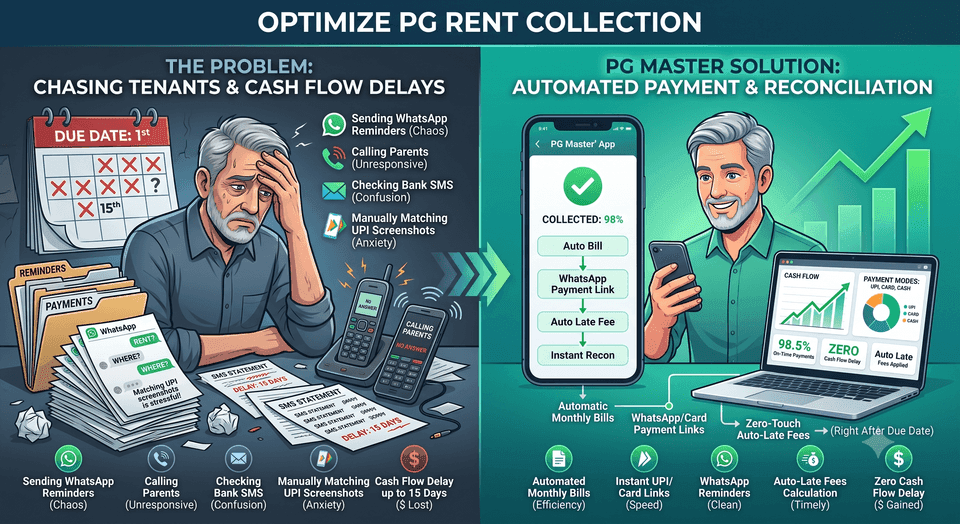
Quick answer: A monthly closing routine gives you the truth about your PG. In order: reconcile every rent payment with your bank or UPI records, follow up on dues, record all expenses, check deposits and refunds, review occupancy and complaints, calculate profit per bed and note actions for next month. Set a fixed date and spend an hour or two. Doing this regularly catches mistakes while they are small.
Many owners run the month and move on. Weeks later, they find a missing payment, an unrecorded expense or a deposit that nobody refunded. By then, nobody remembers the details. A short closing ritual at the end of every month turns that vague feeling of "I think it went fine" into clear numbers and decisions.
When to do it
Choose a regular date, such as the last two days of the month or the first few days of the next, after the rent grace period. Block the time on your calendar. If you have a manager, ask them to prepare their part first.
Part 1: Rent and income
- Download or open your bank statement and UPI report for the month
- Match every credit to a tenant and a month. See UPI vs cash vs bank transfer
- Mark unmatched credits and find out who sent them
- List tenants with unpaid or partial rent
- Apply late fees as per policy, and remove any that were waived
- Record cash collected and confirm it was deposited
- Record other income: food, laundry, electricity, penalties, forfeited tokens
- Confirm receipts were issued
For a deeper look at matching, read the guide on rent reconciliation using bank SMS.
Part 2: Dues and follow-up
- Make a list of overdue tenants with amounts and days overdue
- Send reminders or make calls as per your policy. See what to do when a tenant does not pay
- Note promises to pay with dates
- Flag tenants who repeatedly pay late
- Check deposits against outstanding dues for tenants who are leaving
Part 3: Expenses
- Record all expenses by category. See expense categories
- Check receipts for large items
- Reconcile petty cash with the manager's log
- Pay pending vendor bills
- Verify salaries paid and any advances
- Record electricity, water and gas bills
- Separate one-time investments from running costs
- Note any unusual increase or decrease versus last month
Part 4: Deposits, move-ins and move-outs
- List new joiners and confirm deposits received and recorded
- List move-outs and confirm inspections done
- Settle pending deposit refunds. See security deposit checklist
- Record deductions with reasons and evidence
- Check that vacated beds are marked correctly
Part 5: Occupancy and enquiries
- Calculate occupancy. See how to calculate occupancy
- List vacant beds and how long each has been empty
- Review enquiries, visits and bookings. See enquiry follow-up
- Update listings and availability
- Note upcoming notices and expected vacancies
Part 6: Operations and safety
- Review complaints: opened, closed and overdue. See complaint management
- Review repeated issues
- Check maintenance done against the schedule. See maintenance schedule
- Confirm safety checks and any drills
- Check staff attendance and performance notes
Part 7: Calculate the numbers
Create a one-page summary:
| Metric | This month | Last month |
|---|---|---|
| Rent due | ||
| Rent collected | ||
| Collection rate | ||
| Other income | ||
| Total expenses | ||
| Operating profit | ||
| Occupied beds (average or end of month) | ||
| Occupancy | ||
| Profit per occupied bed | ||
| Overdue amount | ||
| Open complaints |
Use the same format each month so changes stand out. For profit per bed, see profit per bed worked example.
Part 8: Decide and plan
Based on the numbers, write three to five actions for next month. For example:
- Follow up on the five largest overdue accounts
- Reduce food cost per bed by reviewing the vegetable vendor
- Fix the recurring geyser problem on floor 2
- Refresh photos and relist two vacant beds
- Prepare the rent increase notice for January
Assign each action to a person and a date.
Keep the monthly pack
Save the month's reports, bank statement, expense sheet and summary in one folder. You will thank yourself at tax time or when a question arises about a payment. Your CA will also appreciate clean, labelled records. See the tax guide for PG owners.
Common mistakes
- Doing it irregularly
- Skipping reconciliation
- Not matching deposits to dues
- Leaving unmatched payments unresolved
- Mixing personal and business money
- Reviewing only income
- No actions after reviewing
- Not saving the monthly pack
How software helps
Closing is faster when payments, dues and expenses are already recorded. The PG Master Owner App shows paid, pending and overdue rent, bed occupancy and expenses by property, so most of the checklist becomes a review instead of a rebuild. See expense tracking across properties.
Making the routine stick
Block a fixed slot in your calendar and treat it as a meeting you cannot cancel. Prepare in advance: ask the manager to submit the expense log and dues list two days before. Keep the checklist in the same folder each month and tick it off. After three months, you will see how long it takes and which items always cause trouble. Remove steps that add no value and add steps that catch recurring mistakes. The goal is a routine that is short enough to do every month without dreading it.
What a good close tells you
A clean close tells you three things. First, whether the money in your account matches what tenants say they paid. Second, whether your costs match your plan. Third, whether the property is getting better or worse. If you can answer all three in one sitting, you are in control. If you cannot, the checklist shows you which part of your records needs work, and you can fix that part first.
A note on cash and receipts
If any part of your income is in cash, close the cash book separately before you close the month. Count the cash, compare it with the recorded receipts and deposit or record any difference. A mismatch that is found at once is usually a missing entry. A mismatch found months later is a puzzle that nobody can solve. Ask your manager to hand over a signed cash summary on the last day of each month.
Frequently asked questions
How long should a monthly closing take? For one small PG with organised records, an hour or two. It takes longer if records are scattered.
What should I check first? Reconcile rent payments with your bank and UPI records, because everything else depends on accurate income.
Do I need an accountant for this? Not for the routine review, but a CA is helpful for tax, filings and compliance.
What if the numbers do not match? Find the difference, trace unmatched entries, ask the manager or tenant and correct the records the same day.
Should I share the report with my manager? Share the operational parts, such as dues, complaints and occupancy. Share financial details as appropriate to the role.
Next step
Set a calendar reminder for the last two days of each month and run this checklist once. To reduce the manual part, try the PG Master Owner App or book a demo.
Stop Chasing Rent & Juggling Spreadsheets
ApnaRent helps 170+ owners send automated WhatsApp rent reminders, track live bed vacancy, collect digital KYC, and reconcile expenses in real time.