
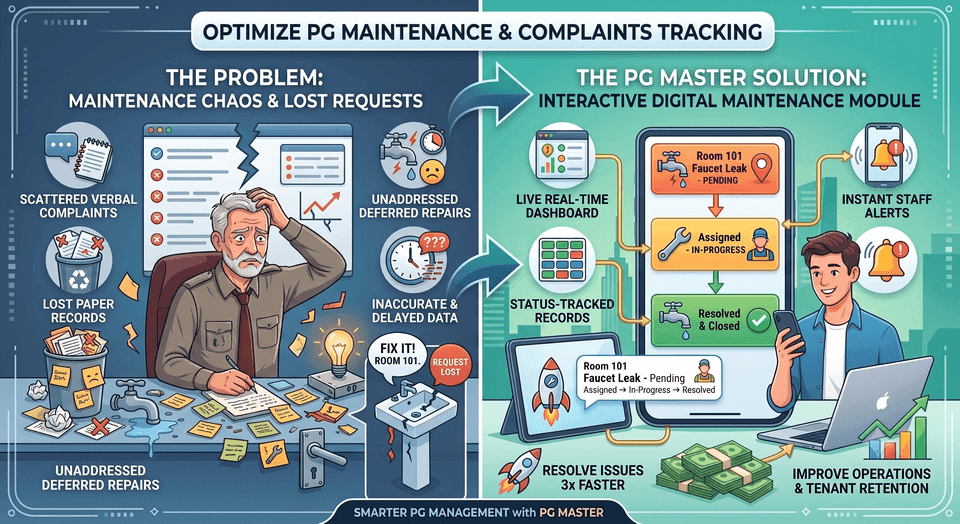
Quick answer: A good PG complaint system does four things: it records every complaint in one place, assigns an owner, sets a target response time and closes the loop with the tenant. Start with a simple ticket list, define three priority levels, review open items weekly and use the patterns you see to prevent repeat problems. Unresolved small issues are a common reason tenants leave.
Ask any PG owner what drains their day and "complaints on WhatsApp" is near the top. A tenant sends a photo of a leaking tap at 10 PM. A second tenant calls about Wi-Fi. A third mentions the geyser to the cook. Nobody writes it down, nobody knows who is handling it and a week later the same tenant sends the same message, angrier.
You do not need a heavy system. You need a habit and a structure.
Why complaint handling matters
- It affects renewals. Tenants who feel ignored move out, even if the rent is fair.
- It affects reviews. Online ratings often mention maintenance and responsiveness.
- It protects assets. A small leak left alone becomes damaged flooring.
- It protects you. A record shows that you acted, which matters in disputes.
- It gives you data. Repeated issues show where to invest.
Step 1: One intake channel
Tenants should know exactly where to report issues. Choose one primary channel, such as an app, a dedicated number or a form, and ask people to use it. Accept messages in other places, but log them into the main system. The goal is that nothing lives only in someone's memory.
Step 2: Capture the same details every time
Each ticket should have:
| Field | Example |
|---|---|
| Ticket number | C-0213 |
| Date and time | 9 Nov, 10:05 PM |
| Tenant and room | Aman, Room 204 |
| Category | Plumbing, electrical, Wi-Fi, housekeeping, food, noise, other |
| Description and photo | Tap leaking in bathroom |
| Priority | High / Medium / Low |
| Assigned to | Plumber / manager |
| Target time | 24 hours |
| Status | Open / In progress / Resolved / Closed |
| Resolution note | Washer replaced |
Photos save time. A picture often tells the plumber what to bring.
Step 3: Three priority levels
Keep priorities simple:
- High (urgent): safety or essential service. Examples: electrical sparks, no water, gas smell, lift stuck, security concern. Respond immediately.
- Medium: affects comfort. Examples: geyser not working, AC fault, Wi-Fi down, leaking tap. Target: same or next day.
- Low: minor or cosmetic. Examples: chipped paint, loose handle. Target: within a week.
These targets are examples. Choose targets you can meet, then publish them. A realistic promise kept beats an ambitious one broken.
Step 4: Assign one owner
Every ticket has one responsible person, even if several people help. "Someone will look at it" means nobody will. Assign it to the manager, the maintenance person or a vendor, and record who.
Step 5: Update the tenant
Tenants forgive delays when they know what is happening. Send a short message at each stage:
- "We have logged your complaint. Ticket C-0213. Plumber is coming by 6 PM tomorrow."
- "Resolved. Please confirm that it is working."
When tenants can see status, they do not need to ask again.
Step 6: Close with confirmation
Do not close a ticket just because the work was done. Ask the tenant if it is resolved. If yes, close. If no, reopen. This one habit stops a lot of repeat complaints.
Step 7: Review weekly
Spend 20 minutes each week on:
- open tickets older than their target
- tickets reopened
- complaint types that repeat
- rooms or floors with the most issues
- vendors who are slow
Patterns lead to decisions. Ten Wi-Fi complaints may mean a router upgrade. Repeated geyser failures in one block may mean a wiring or maintenance fix. Repeated food complaints may mean a menu review. See mess and food cost control.
Escalation rules
Decide what happens if the target is missed:
- Past target: notify the manager.
- Twice the target: notify the owner.
- High priority unresolved after [few hours]: owner calls the tenant directly.
Escalation keeps things from rotting quietly.
Common mistakes
- No log. Complaints disappear into chat history.
- No priorities. A minor paint issue gets the same attention as a power fault.
- No timeline. Tenants do not know when to expect help.
- Fixing symptoms. Replacing the same part again and again without finding the cause.
- Blaming tenants first. Check for faults before assuming misuse.
- Argument in public groups. Handle complaints one to one.
- Not thanking tenants who report issues early.
Sample response times you could publish
| Priority | First response | Target resolution |
|---|---|---|
| High | Within 1 hour | Same day |
| Medium | Within 4 hours | 24 to 48 hours |
| Low | Within 24 hours | 7 days |
Adjust to your property, staff and vendors. Add this to your house rules.
How software helps
A complaint module saves the tenant, manager and owner from chasing each other. The PG Master Owner App supports a tenant app where residents can raise issues, and staff can be given role-based access so each person sees what they need. Read about tenant management and role-based warden permissions.
A one-week pilot you can run now
Pick one floor. For seven days, ask tenants on that floor to send every issue to a single number and log each one in a sheet with the fields above. At the end of the week, count the tickets, see how many closed within target and list the repeat problems. Most owners find two or three issues that account for the majority of tickets, such as Wi-Fi drops or a weak geyser. Fixing those few causes reduces the number of messages more than answering each message faster. Then extend the log to the whole building.
Training tenants to use the system
A ticket system fails if tenants do not use it. At joining, show the channel on your phone and raise a test ticket together. Put the number or QR code on the notice board. Reply to the first few tickets very quickly so people see that it works. When a tenant sends an issue by another route, log it yourself and gently remind them of the main channel. After a month, ask what is confusing and simplify. The goal is a habit that feels easy for tenants, not extra paperwork for them.
Frequently asked questions
What is a good response time for PG complaints? Respond to urgent issues immediately, and set realistic targets for others, such as same or next day for comfort issues and within a week for minor ones.
Should every complaint go through the owner? No. Set a manager as first responder and escalate only delays or serious issues.
How do I handle noisy neighbour complaints? Log them, speak to both sides, refer to the house rules and record the outcome.
Can I use WhatsApp for complaints? You can, but log each one in a ticket list so it is not lost.
How do complaints relate to renewals? Quick, visible resolution tends to improve satisfaction and reduces the chance of tenants leaving over small issues.
Start small
Create a ticket sheet today, define three priorities and review it every week. When volume grows, use a tool that tracks it for you. Try the PG Master Owner App or book a demo.
Stop Chasing Rent & Juggling Spreadsheets
ApnaRent helps 170+ owners send automated WhatsApp rent reminders, track live bed vacancy, collect digital KYC, and reconcile expenses in real time.

More from ApnaRent
View all articles Starting a PG
PG vs Hostel vs Co-Living: Which Model Should You Run?
ApnaRent · 6 Jan 2027 · 7 min
 Finance and Profit
PG Owner KPIs: 10 Metrics to Track to Grow Profit
ApnaRent · 5 Jan 2027 · 7 min
 Finance and Profit
PG Owner's Monthly Closing Checklist: Rent, Expenses and Reports
ApnaRent · 2 Jan 2027 · 7 min