
Quick answer: There is no single best day, but most PGs choose either a common due date (such as the 1st to the 5th) or a cycle based on each tenant's joining date. A common date is easier to manage and reconcile. A joining-date cycle spreads payments across the month and avoids pro-rata calculations. Pick the one that fits your size and tenant type, add a clear grace period and send reminders before the due date.
The due date looks like a small detail, but it shapes your cash flow, your workload and how often you chase people. A date that fits tenants' pay cycles gets paid on time. A date that clashes with them creates routine delays.
Option 1: One common due date for everyone
All tenants pay by the same day each month, such as the 1st or the 5th.
Pros
- Simple to explain and remember
- All collection work happens in one window
- Easy reconciliation and reporting
- Clear monthly cash flow
- Easy to see who is late
Cons
- New tenants who join mid-month need pro-rata rent for the first month. See how to pro-rata rent
- Heavy workload on and after the due date
- If it clashes with salary dates, many tenants pay late together
Option 2: Joining-date cycle
Each tenant's rent is due on the same day of the month they joined, such as the 12th for someone who joined on the 12th.
Pros
- No pro-rata rent for the first month
- Payments spread across the month
- Natural fit for flexible joiners
Cons
- Harder to track without software or a clear sheet
- Your income is spread out, which can make month-end reporting less neat
- More reminder dates to manage
- Notice and move-out timing are less aligned with the calendar
Option 3: Hybrid
Use a common due date for most, but allow a short transition for first-time payments. For example, new tenants pay a pro-rata amount for the first partial month and then move into the common cycle.
How salary dates affect payment
Working professionals often receive salary at the end or start of the month, but not always. If your due date is the 1st and many tenants are paid on the 3rd or later, you may see a wave of late payments every month. Ask your tenants when they get paid. If most are paid at month-end, a due date between the 1st and 5th usually suits. If they are paid mid-month, think about it carefully.
Students often depend on family transfers, which may happen at different times. A due date with a grace period and reminders works better than a rigid line.
Choosing: a simple decision guide
| Your situation | Suggested approach |
|---|---|
| Small PG, few tenants, spreadsheet | Common date for simplicity |
| Larger PG with software | Either; joining-date cycle is workable |
| Student-heavy, same semester start | Common date aligned with semester start |
| Many mid-month joiners | Joining-date cycle or hybrid |
| Mostly salaried tenants paid at month-end | Common date within the first days of the month |
Add a grace period
A due date with no grace period creates conflict over small delays. A short grace period, such as a few days, acknowledges real-world delays. Late fees start after the grace period. Make this clear in the agreement. See PG late fee policy.
Send reminders before and on the due date
Even good tenants forget. A simple schedule:
| When | Message |
|---|---|
| 3 days before | Friendly reminder with payment link |
| On the due date | Reminder with amount and link |
| Day after grace period | Late fee notice and request |
| Persistent delay | Personal call and written notice |
See how to send rent reminders on WhatsApp and the guide on automated rent reminders.
Match due dates with your own costs
Your own payments, such as landlord rent, salaries and vendor bills, have due dates too. If you must pay the landlord on the 5th and tenants pay on the 10th, you carry a gap. Try to set tenant due dates before your major payments, or keep a cash buffer.
Changing the due date
If you decide to change, do it carefully:
- Give written notice well in advance.
- Explain the reason and the new date.
- Handle the transition month fairly, with a short or adjusted cycle.
- Update agreements for new tenants.
- Do not change dates frequently.
Common mistakes
- No stated due date in the agreement
- Due date that clashes with tenants' pay cycle
- No grace period or reminders
- Changing dates without notice
- Different dates for similar tenants without a reason
- Not aligning with your own bills
- Waiting until the due date to remind
How software helps
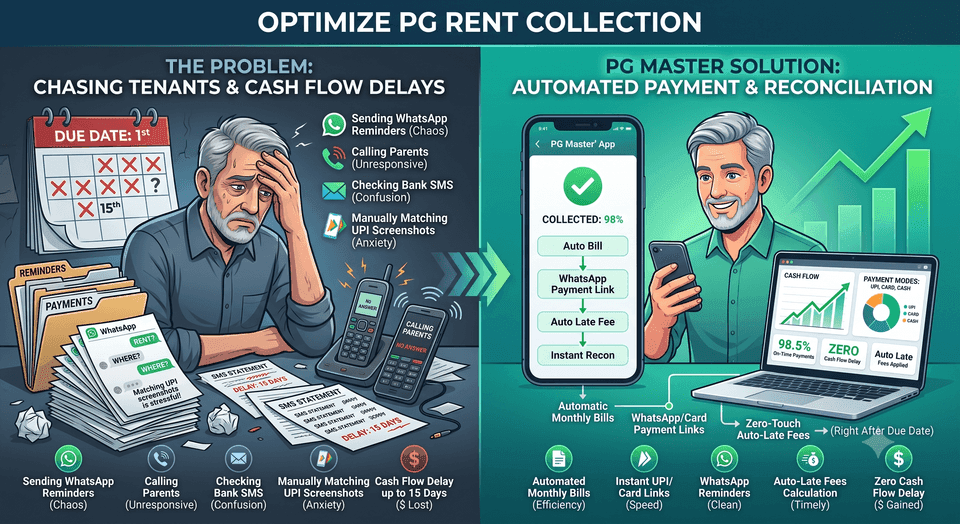
Due dates become simple when software handles reminders, payment links and status. The PG Master Owner App shows paid, pending and overdue rent and can send reminders by WhatsApp and app, whether your cycle is common or based on the joining date. See the rent collection guide and the post on reducing late rent payments.
A worked example
Suppose your PG has 40 tenants. Thirty are salaried and paid at the end of the month, and ten are students who receive family transfers around the first week. You compare two choices. With a due date of the 1st and a grace period of three days, most salaried tenants can pay on time, but students often will not. With a due date of the 5th and a three-day grace period, almost everyone can pay on time, and you can send the first reminders on the 2nd. You also look at your own costs: if your landlord's rent is due on the 7th, the 5th still gives you a small buffer. The 5th is the better fit in this example. Your numbers may point to a different answer, which is why asking tenants and checking your own bills matters more than copying a rule.
Frequently asked questions
What is the best rent due date for a PG? There is no universal answer. Many PGs use a common date early in the month, while others use each tenant's joining date. Choose what suits your tenants and your systems.
Should the due date be the 1st of the month? It can work if tenants are paid by then. If many are paid later, a date a few days into the month may reduce late payments.
Is a joining-date cycle better? It avoids pro-rata rent and spreads payments, but needs better tracking.
How long should the grace period be? Choose a short period that is fair and state it in the agreement.
Can I change the due date for existing tenants? Yes, with clear notice and a fair transition, subject to your agreement.
Next step
Ask your tenants when they receive salary or family transfers, then review your due date and grace period. To automate reminders and track status, try the PG Master Owner App or book a demo.
Stop Chasing Rent & Juggling Spreadsheets
ApnaRent helps 170+ owners send automated WhatsApp rent reminders, track live bed vacancy, collect digital KYC, and reconcile expenses in real time.

More from ApnaRent
View all articles Starting a PG
PG vs Hostel vs Co-Living: Which Model Should You Run?
ApnaRent · 6 Jan 2027 · 7 min
 Finance and Profit
PG Owner KPIs: 10 Metrics to Track to Grow Profit
ApnaRent · 5 Jan 2027 · 7 min
 Finance and Profit
PG Owner's Monthly Closing Checklist: Rent, Expenses and Reports
ApnaRent · 2 Jan 2027 · 7 min