
Quick answer: A fair PG late fee policy has four parts: a clear due date, a short grace period, a reasonable fee (flat or per day, with a cap) and a written clause in the agreement that the tenant has accepted. Apply it to everyone, remind tenants before the due date and record every fee. Fees are meant to encourage on-time payment, not to punish.
A late fee works only if tenants know about it before they pay late. If you introduce a charge after the fact, it feels like a penalty and invites arguments. If it is written in the agreement, explained at joining and applied the same way to everyone, most tenants simply pay on time.
This guide helps you design a policy that is clear, fair and easy to run. It is general information, not legal advice.
Why have a late fee at all?
Late rent costs you more than the delay. You spend time chasing, your cash flow suffers and you may pay your own bills late. A modest late fee signals that the due date matters and gives tenants a reason to plan.
Be honest about the goal: you want rent on time, not extra income from fees. If your policy produces many fees, the problem is usually unclear due dates or difficult payment methods, not tenants.
The four decisions
1. Due date
Choose one due date for everyone, such as the 5th or 7th. Many owners align it with salary dates so tenants have money in hand. Read which rent due date works best.
2. Grace period
A grace period of two to five days gives room for small delays, such as a bank holiday or a failed payment, without a fee. It also reduces arguments. Decide the length and state whether weekends and holidays count.
3. Fee structure
There are three common models.
| Model | How it works | Example | Best for |
|---|---|---|---|
| Flat fee | One fixed amount once the grace period ends | ₹300 after the 8th | Simplicity |
| Per-day fee | A set amount for each day late | ₹50 per day | Encouraging fast payment |
| Per-day with cap | Per-day fee up to a maximum | ₹50 per day, up to ₹500 | Fairness for long delays |
A per-day fee with a cap is often seen as the fairest, because the tenant knows the maximum risk.
4. Fee amount
Keep the fee proportionate to the rent. A very high fee looks unreasonable and may be difficult to defend in a dispute. A tiny fee has no effect. Compare with nearby PGs and think about what a typical delay costs you. Avoid compounding fees or interest on fees.
Worked examples
All numbers are illustrative.
Policy: Rent due on the 5th. Grace period 3 days (until the 8th). Late fee ₹50 per day from the 9th, capped at ₹500.
| Tenant | Payment date | Days late after grace | Late fee |
|---|---|---|---|
| A | 7th | 0 | ₹0 |
| B | 10th | 2 | ₹100 |
| C | 15th | 7 | ₹350 |
| D | 28th | 20 | ₹500 (capped) |
Flat fee policy: ₹300 once rent is more than 3 days late.
| Tenant | Payment date | Late fee |
|---|---|---|
| A | 7th | ₹0 |
| B | 10th | ₹300 |
| C | 28th | ₹300 |
Sample clause for your agreement
Adapt this wording with your own figures, and have it reviewed by a local lawyer if you can:
The monthly rent is due on or before the [5th] day of each month. A grace period of [3] days is allowed. If rent is not received by the end of the grace period, a late fee of ₹[50] per day will be charged from the [9th] day until payment, subject to a maximum of ₹[500] per month. The late fee is a charge for delayed payment and does not waive the Owner's other rights under this agreement.
Also state how payment is recorded: the date the amount reaches the owner's account, not the date the tenant initiates it. And say what happens if a payment fails or is reversed.
How to communicate the policy
A policy no one remembers will not help. Tell tenants:
- At joining. Explain the clause during onboarding. See the onboarding checklist.
- In house rules. Include a one-line summary.
- Before the due date. A reminder message with the date and the fee rule. Our rent reminder templates include the wording.
- After the due date. A message with the amount of fee now applicable.
When to waive a late fee
Flexibility can build goodwill, but it needs a rule so that it feels fair:
- Waive for genuine problems, such as a bank outage or hospital emergency, when the tenant tells you early.
- Record the waiver, the reason and the date.
- Do not waive for tenants who are late every month.
- Avoid verbal "I'll forget it this time" promises that you cannot track.
A good approach is to allow one waiver per tenant per year, noted in writing.
Mistakes that cause disputes
- No written clause. The fee cannot easily be justified.
- Different rules for different tenants. It looks unfair and can lead to complaints.
- Hidden or changing fees. Do not change the policy mid-stay without notice and agreement.
- Excessive amounts. Fees that look punitive create conflict.
- Not counting payment date correctly. Be clear about the date the payment reaches you.
- Charging a fee for your own delay. For example, if the payment link failed on your side.
- Poor records. Without a payment history, a tenant's "I paid on time" is hard to disprove.
What to do if a tenant disputes the fee
- Stay calm and check your records for the payment date and the fee calculation.
- Show the clause and how you calculated the amount.
- If you made an error, correct it quickly and say so.
- If the tenant has a genuine reason, consider a one-time waiver and record it.
- If the dispute continues, follow the steps in our post on what to do when a PG tenant does not pay rent.
Let a system apply the rule
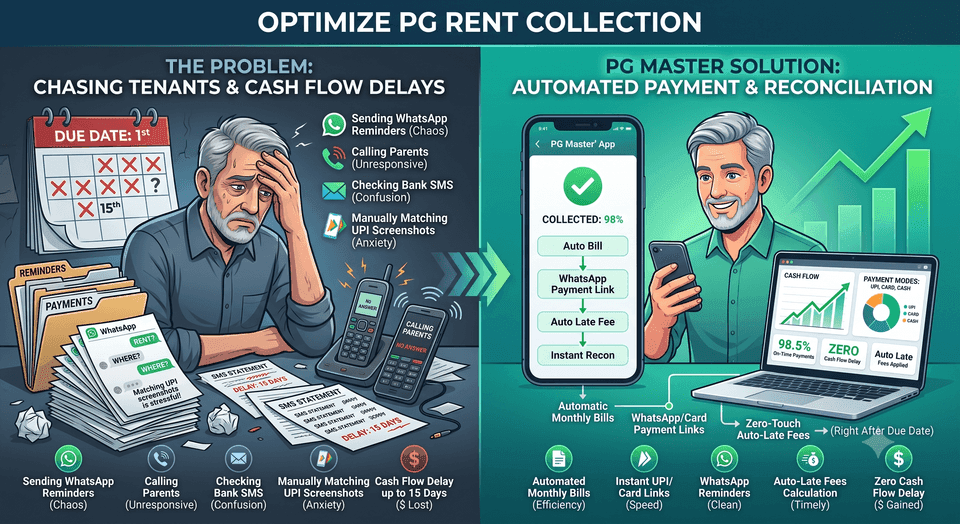
Manual late-fee calculations are slow and easy to get wrong, especially with partial payments and holidays. The PG Master Owner App lets you set a grace period and a flat or per-day fee, applies it automatically and shows paid, pending and overdue status for each tenant. Read the guide to late fee calculation rules and automated rent reminders.
Policy checklist
- One due date for all tenants
- Grace period decided and written
- Fee model chosen: flat, per-day or per-day with cap
- Fee amount reasonable and capped
- Clause added to the agreement
- Policy explained at joining
- Reminders sent before the due date
- Waiver rule defined
- Fees recorded for every tenant
Frequently asked questions
Can a PG owner charge a late fee on rent? Owners commonly include late fees in the agreement. The fee should be agreed in writing and be reasonable. For specific legal questions, speak to a local lawyer.
How much late fee is reasonable? There is no universal figure. Choose an amount that encourages timely payment without being punitive, and compare it with the norm in your area.
Should I give a grace period? Most owners do, usually two to five days, because it reduces disputes over small delays.
Can I charge interest on late rent? Some agreements include interest, but a simple, capped late fee is easier to explain and administer. Avoid compounding charges.
What if my agreement does not mention late fees? Add a clause for future agreements, and discuss changes with existing tenants. Introducing a fee without agreement is likely to cause conflict.
Make it automatic
A written policy and an automatic system together remove most late-fee arguments. Try the PG Master Owner App or book a demo.
Stop Chasing Rent & Juggling Spreadsheets
ApnaRent helps 170+ owners send automated WhatsApp rent reminders, track live bed vacancy, collect digital KYC, and reconcile expenses in real time.

More from ApnaRent
View all articles Starting a PG
PG vs Hostel vs Co-Living: Which Model Should You Run?
ApnaRent · 6 Jan 2027 · 7 min
 Finance and Profit
PG Owner KPIs: 10 Metrics to Track to Grow Profit
ApnaRent · 5 Jan 2027 · 7 min
 Finance and Profit
PG Owner's Monthly Closing Checklist: Rent, Expenses and Reports
ApnaRent · 2 Jan 2027 · 7 min