
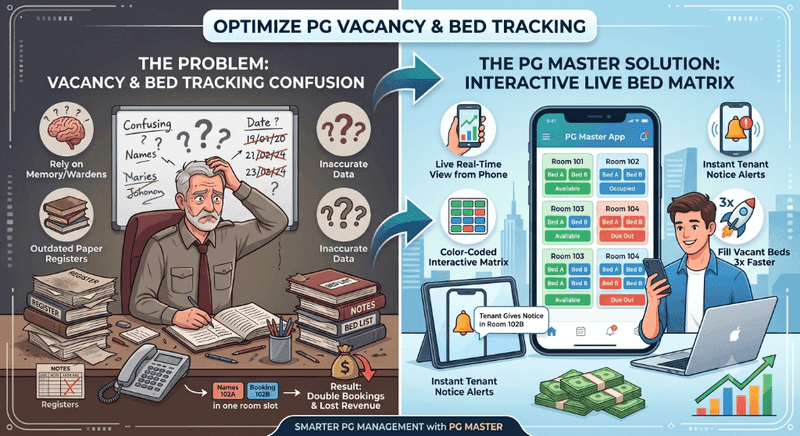
Quick answer: An empty bed costs you its daily rent for every day it stays empty. A bed that rents for ₹6,000 a month costs about ₹200 a day. Ten beds empty for 15 days each cost roughly ₹30,000 in lost rent, while your fixed costs stay the same. The loss is invisible unless you track it.
When rent is not paid, you notice it. When a bed is empty, nothing happens. No notification, no overdue list. Money just does not arrive. That is why vacancy quietly drains more income than late payments in many PGs.
This guide shows how to put a number on it and what to do about it.
The simple formula
Cost of one empty bed per day = Monthly rent of the bed ÷ 30
Vacancy loss = Number of empty beds × Days empty × Daily rent per bed
Example (illustrative figures):
- Rent per bed: ₹6,000 a month, so ₹200 a day.
- You have 8 beds that were empty for an average of 12 days this month.
8 × 12 × ₹200 = ₹19,200 lost in one month.
Over a year at the same rate, that is ₹2,30,400, which could pay for a lot of improvements or software.
The cost is bigger than the rent
Lost rent is only the direct cost. Empty beds also cost you in other ways:
- Fixed costs keep running. Building rent, staff salaries, internet and electricity base charges do not fall when a bed is empty.
- Cleaning and repainting. Each move-out may need cleaning and minor repairs.
- Marketing effort. Time spent on calls, visits and listings.
- Opportunity cost. The tenant who would have joined may take another PG.
You can add an "effort cost" to your calculation if you want a fuller picture, but even the rent alone is usually surprising.
Example by PG size
These figures are illustrative. Replace them with your own.
| PG size | Rent per bed | Average empty beds | Monthly loss | Yearly loss |
|---|---|---|---|---|
| 20 beds | ₹6,000 | 3 | ₹18,000 | ₹2,16,000 |
| 50 beds | ₹6,000 | 6 | ₹36,000 | ₹4,32,000 |
| 100 beds | ₹6,000 | 10 | ₹60,000 | ₹7,20,000 |
Notice that even modest vacancy produces a loss comparable to a salary or a year of rent on a small flat.
Where vacancy really comes from
Most owners think vacancy is caused by a weak market. In practice, a large part comes from process gaps:
- Late notice awareness. The tenant told your manager on the 5th, but you learned on the 28th, so marketing started too late.
- Slow follow-up. Enquiries wait two days for a reply and go elsewhere.
- Slow turnaround. The room takes a week to clean, repair and photograph.
- No waiting list. When a bed empties, you start from zero.
- Wrong price. A bed priced too high for its sharing type or condition stays empty longer.
- Poor visibility. Nobody can see at a glance which beds are empty or will be soon.
Each of these is fixable without changing your building or location.
Five ways to shorten vacancy gaps
1. Track notice periods and start marketing early
Make a list of tenants on notice and the date each bed will be free. Begin showing the bed 10 to 15 days before the move-out date. A system that flags notice periods automatically prevents surprises. See the notice period tracking guide.
2. Reply to enquiries quickly
Speed wins admissions. Many seekers contact several PGs at once and choose whoever replies first with clear details. Keep a short reply ready with price, sharing type, deposit and photos. Our post on a walk-in and enquiry follow-up system shows how to organise this.
3. Prepare rooms within 48 hours
Create a move-out checklist: inspect, repair, clean, repaint if needed, replace linen and take fresh photos. Assign each step to a person with a deadline. See the move-out checklist for owners.
4. Keep a waiting list
Whenever you turn away someone because you are full, note their name, number, budget and preferred sharing type. When a bed opens, call the list first.
5. Price each bed sensibly
If a bed has been empty for more than two weeks while others in the same category filled, review the price or what you offer. A small, planned discount for a quick join can beat an empty bed. Read how to set rent per bed and the guide to dynamic room pricing.
A weekly 10-minute vacancy review
Every Monday, answer these five questions:
- How many beds are empty today?
- How many will be empty in the next 15 days?
- Which beds have been empty longest, and why?
- How many enquiries came in, and how many were followed up within 2 hours?
- What is one thing I will do this week to fill beds?
This simple habit is often more effective than any campaign.
Using technology to see vacancy instantly
A live bed matrix removes guesswork. The PG Master Owner App shows vacant, occupied and notice-period beds in one colour-coded view, filtered by sharing type, with one-tap bed shifting. You can read more about the live bed vacancy matrix and how to calculate your PG occupancy rate.
Common mistakes
- Judging vacancy by month-end count only.
- Counting a bed as full once the tenant has given notice.
- Waiting for the tenant to leave before advertising.
- Keeping the same price for every bed regardless of demand.
- Having no record of past enquiries.
A quick way to see the cost in your own PG
Pick one bed that stayed empty for the last two months. Multiply its monthly rent by the number of empty months, then add the extra costs you still paid for that bed, such as food prepared in advance, electricity for a cooled room and housekeeping. The total is usually larger than owners expect, because it is rarely written down in one place. Do the same for each long-empty bed and add them up. That figure is the amount you can spend on photos, a better listing, a referral reward or a small repair and still come out ahead. Repeat the exercise every quarter so that a vacancy is treated as a cost to remove, not as bad luck.
Frequently asked questions
How do I calculate the cost of an empty bed? Divide the monthly rent by 30 to get the daily rent, then multiply by the number of days the bed stays empty.
What is a normal vacancy period between tenants? It varies by city, season and tenant type. Instead of aiming for an industry average, measure your own average vacancy days and try to reduce it steadily.
Is it better to lower rent or keep a bed empty? Compare the discount against the rent lost per empty day. A short-term, clearly limited offer often costs less than leaving a bed empty for weeks. Avoid permanent discounts that lower your price for all future tenants.
How can I find out which beds will be empty soon? Track notice periods. A system that shows tenants on notice and their last day gives you an early view.
Does vacancy affect profit more than late rent? Both matter. Late rent delays money, while vacancy removes it permanently, so it is worth measuring separately.
Put a number on it this week
Calculate your own vacancy loss for the last three months. If the number is larger than you expected, start with the weekly review above, and consider the PG Master Owner App to track vacancy daily. Want a walkthrough? Book a demo.
Stop Chasing Rent & Juggling Spreadsheets
ApnaRent helps 170+ owners send automated WhatsApp rent reminders, track live bed vacancy, collect digital KYC, and reconcile expenses in real time.

More from ApnaRent
View all articles Starting a PG
PG vs Hostel vs Co-Living: Which Model Should You Run?
ApnaRent · 6 Jan 2027 · 7 min
 Finance and Profit
PG Owner KPIs: 10 Metrics to Track to Grow Profit
ApnaRent · 5 Jan 2027 · 7 min
 Finance and Profit
PG Owner's Monthly Closing Checklist: Rent, Expenses and Reports
ApnaRent · 2 Jan 2027 · 7 min