
Quick answer: Running a PG in a leased building needs less upfront money and lets you scale or exit faster, but the rent is a fixed cost and the landlord can change terms at renewal. Owning gives control and potential property appreciation, but ties up capital, takes longer to scale and brings maintenance and tax responsibilities. Compare both using break-even occupancy, cash invested, risk and your plan, and take advice from a CA before committing.
Many people entering the PG business start with a building they inherited or own. Others start by leasing a building and converting it to a PG. Neither path is automatically better. The right answer depends on your money, your time horizon and how you want to grow. This guide offers a framework with illustrative numbers. Replace them with your own.
The core difference
| Factor | Leased building | Owned building |
|---|---|---|
| Upfront money | Deposit to landlord, fit-out, furniture | Purchase or construction cost, plus fit-out |
| Monthly cost | Rent (fixed, may rise) | Loan EMI (if any), property tax, maintenance |
| Control | Limited by lease terms | Full control |
| Scaling | Faster if you can lease more buildings | Slower, needs capital for each building |
| Exit | Easier, subject to lease terms | Needs sale or other use |
| Appreciation | None for you | Possible, not guaranteed |
| Risk | Landlord disputes, rent hikes, non-renewal | Capital locked, market risk, vacancy |
Leasing: strengths and risks
Strengths
- You can start with limited capital.
- You can test a location before committing larger sums.
- You can open several properties and learn what works.
- Your capital focuses on operations: furnishing, hiring and marketing.
Risks
- The landlord may raise rent heavily or not renew.
- You invest in fit-out in a building you do not own.
- A long lock-in leaves you paying rent even in a weak period.
- The landlord may object to the PG use or the number of occupants.
- Disputes over deposit return or repairs.
What to check in the lease
- Does the lease clearly permit PG or hostel use?
- Duration, lock-in and renewal terms
- Rent escalation per year
- Who pays property tax, maintenance and repairs
- Whether you can modify the building
- What happens to your fit-out at exit
- Notice and termination terms
- Registration and stamp duty requirements in your state
Have the lease reviewed by a lawyer, because a poorly drafted lease is the main risk in a leased model.
Owning: strengths and risks
Strengths
- No rent to a landlord and no renewal risk
- You decide how to use and improve the building
- Potential value appreciation over the long term
- Stability for tenants and staff
Risks
- A large amount of money is tied up in one building
- A loan creates a fixed EMI whatever your occupancy
- Property market can be slow or fall
- You carry maintenance and tax responsibilities
- Lack of diversification if all capital is in one property
A simple comparison method (illustrative)
Use the same PG in two scenarios and compare. The numbers below are not market data. Replace with yours.
Assume a 30-bed PG, 80% occupied (24 beds) at ₹9,000 per bed per month.
- Monthly income: 24 × 9,000 = ₹2,16,000
Leased scenario
- Rent to landlord: ₹80,000
- Other running costs (salaries, food, utilities, maintenance): ₹95,000
- Operating profit: 2,16,000 − 80,000 − 95,000 = ₹41,000
- Capital invested: fit-out and deposit, say ₹X
Owned scenario
- No rent, but EMI of ₹[amount] if you borrowed, or an opportunity cost on your capital
- Other running costs: ₹95,000
- Profit depends on EMI or the return you could earn elsewhere
- Capital invested: purchase cost plus fit-out, say ₹Y
The honest comparison is return on the capital invested, plus risk. If ₹Y is many times ₹X, a leased PG may deliver a better return per rupee invested, even if the profit in rupees is lower. If you already own the building and it would otherwise sit idle or rent cheaply, the owned model may be better.
Questions to ask yourself
- How much capital can I commit without strain?
- Do I want to build a chain or run one property?
- How long will I stay in this business?
- Can I survive a 3 to 6 month slow period?
- What happens if the landlord does not renew?
- Do I have the time to manage several buildings?
- What return would I get if I invested the same capital elsewhere?
Calculate break-even for both
Whichever model you choose, calculate your break-even occupancy: the percentage of beds you must fill to cover all costs. Leased models usually have a higher fixed cost per month and so a higher break-even. See break-even occupancy for a PG. A safe plan has a break-even well below your realistic occupancy.
Hybrid options
- Own one, lease others. Anchor with your own building and grow by leasing.
- Revenue share with landlords. Some arrangements pay a share of income instead of fixed rent. Make terms clear and legally sound.
- Long lease with a clear escalation schedule. This gives stability without buying.
Common mistakes
- Signing a lease without legal review
- Spending heavily on fit-out in a short lease
- Ignoring escalation
- Underestimating deposit and working capital
- Buying a building only for a PG without market study
- Not accounting for vacancy
- Over-borrowing
How software helps
Whichever model you choose, you need a clear view of income, costs and occupancy per property. The PG Master Owner App tracks properties, rent collection and expenses, and supports multiple properties from one login. See multi-property chain control and the guide on expense tracking.
A decision framework in three questions
First, what is the cost of capital for you? If purchasing a building means borrowing or giving up other investments, include that cost in the owned scenario. Second, how long do you expect to run this PG? Short horizons favour leasing, long horizons favour owning if the location is strong. Third, what could go wrong in each case? List the top two risks, such as a landlord who will not renew or a market with falling demand, and ask whether you could survive each one. The option that you can survive in a bad year is usually the safer choice, even if it looks less exciting on paper.
Frequently asked questions
Is it better to rent or buy a building for a PG? It depends on your capital, risk tolerance and growth plans. Leasing needs less upfront money; owning gives control and possible appreciation. Compare returns on capital and break-even occupancy.
How long should a PG lease be? Long enough to recover your fit-out investment, with clear renewal and escalation terms. Ask a lawyer to review.
Can I run a PG in a rented flat? It depends on the lease, building rules and local regulations. Get the landlord's written permission for PG use.
What deposit do landlords usually ask for? It varies widely by city and property. Negotiate and document refund conditions.
How many beds do I need to be profitable? Work out your break-even occupancy using fixed and variable costs.
Next step
Build a simple two-column comparison with your own numbers, then talk to a CA before you commit. To track each property's income and costs together, try the PG Master Owner App or book a demo.
Stop Chasing Rent & Juggling Spreadsheets
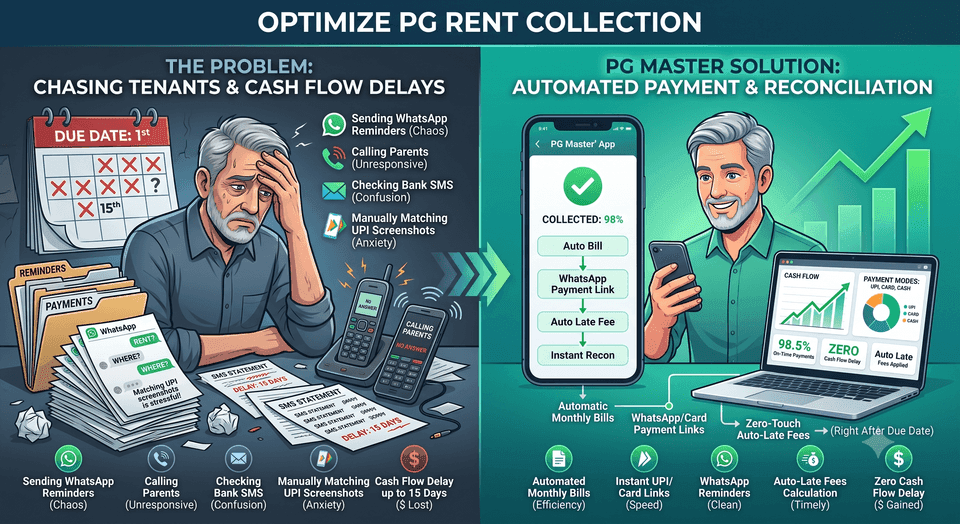
ApnaRent helps 170+ owners send automated WhatsApp rent reminders, track live bed vacancy, collect digital KYC, and reconcile expenses in real time.

More from ApnaRent
View all articles Starting a PG
PG vs Hostel vs Co-Living: Which Model Should You Run?
ApnaRent · 6 Jan 2027 · 7 min
 Finance and Profit
PG Owner KPIs: 10 Metrics to Track to Grow Profit
ApnaRent · 5 Jan 2027 · 7 min
 Finance and Profit
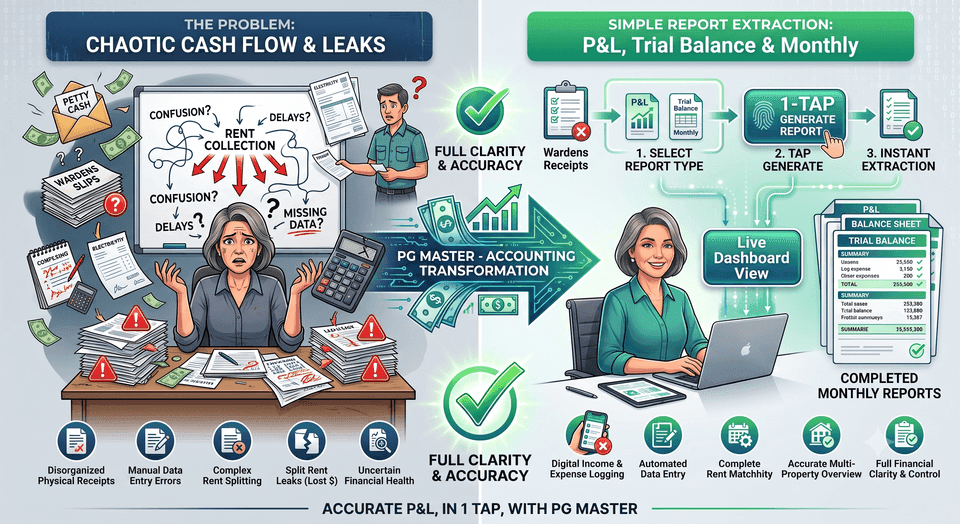
PG Owner's Monthly Closing Checklist: Rent, Expenses and Reports
ApnaRent · 2 Jan 2027 · 7 min